

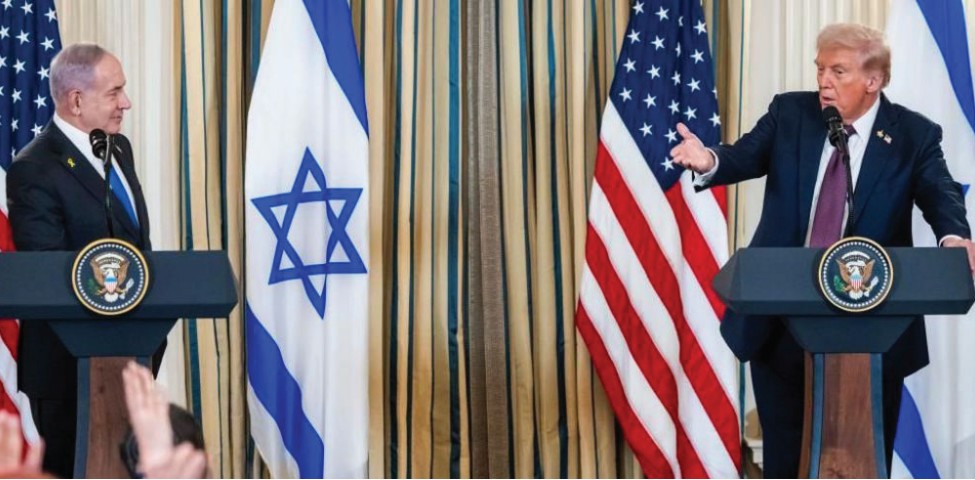
After many boycotts and protests, the world reached a verdict as Trump recently signed the 2025 Gaza truce agreement that has been hailed by his administration as the final ‘peace in the Middle East’. The agreement signed in Egypt allowed for more than 1700 detained Palestinians and the last of the 20 living Israeli hostages to be released, while Hamas handed over the remaining eight slain captives to Israel via the Red Cross.
Earlier, the twenty-point plan laid by the Trump administration to settle the question of a long-lasting peace in Gaza’s genocide, was met by a guarded nod by all actors. On paper, the plan appeared sweeping as it envisioned Gaza as a ‘terror-free’ demilitarised zone. It not only ensured the full return of hostages in exchange for Palestinian prisoners but also called for the resumption of humanitarian assistance as a gesture of goodwill, whereby both parties assent to ending hostilities. While the pointers raised do seem reasonable on paper and do pay lip service to the notion of ‘Palestinian statehood’ and the right to self-determination, whether this scaffold of a ceasefire can become something more durable is yet to be seen.
Despite the exchange, a fragile peace holds with violations occurring regularly, as nine Palestinians have recently been killed by Israeli fire, with many Palestinians still not allowed to enter Israeli-occupied zones. Furthermore, only 300 of the 600 aid trucks are allowed into Gaza despite ceasefire stipulations and UN pressure. A major ceasefire clause calls for the disbanding and demilitarisation of Hamas members and instead calls for Gaza’s administration to be envisioned under a Palestinian technocratic committee that will be overseen by an international ‘Board of Peace’ created by the Trump administration itself. However, tensions remain high owing to Hamas’ reservations over the Palestinian administration being run by ‘Palestinians only’, and it does not help that Trump continues to warn Hamas that it will be ‘violently disarmed’ if it does not do so on its own at the quickest.
ssues on whether the ceasefire will hold are also linked to how the clauses appear to be asymmetrical, whereby Hamas is tasked to return all the hostages, but this is neither phased nor monitored. Originally, the release of prisoners should have been time-bound, and monitors should have been in place to guarantee an end to bombing to ensure that Israel holds its end of the bargain. Hence, such forms of asymmetry tend to be fatal when it comes to conflict diplomacy, given that, despite ongoing negotiations, Israel once again bombed Palestine’s Tufaa city, whereby 70 were killed, and continued with the mistreatment and capture of Flotilla captives. It seemingly appears that the deal does not benefit both sides equally, as one side must pay fully while the other is forced to pay in ‘installments’, making this deal dubious.
Secondly, Hamas has already signalled resistance towards ‘non-Palestinian’ control over ‘Palestinian’ land despite the ceasefire agreement. While they agreed to Trump’s twenty-point ceasefire but they did demand clarity over who Palestinian control will ultimately lie with and who the external body of influence will be, even if an agreement over a Palestinian technocratic rule was agreed upon. Even those Palestinians resistant to Hamas’ control may be skeptical towards an externally imposed structure, especially one that rests on Tony Blair’s input, owing to his notorious role during the Iraq war. If territorial control comes under external sovereigns in the name of ‘rebuilding’ and ‘peace’, even if not Israeli, it only seeks to undermine the plight of Palestinian sovereignty.
Furthermore, agreeing that all weapons in Gaza must be destroyed and never be rebuilt seems like a tough guarantor whereby Gaza must trade its security for Israeli security in the hopes of securing its freedom. Fur – thermore, demilitarisation is a lengthy process that re – quires multiple stages which can be easily undermined if one troublemaker decides to run amok. This could easily only lead to an Israeli excuse for further re-militarisation, hence jeopardising peace.
By signing this agreement, Hamas must confront an exHowever, there have been many critiques on various social media fronts against Pakistan’s role, upon which the Foreign Minister’s reply was clear. He stated that the White House text is not identical to the original Muslim draft. The differences, he insists, can and should be negotiated to ensure defined recognition of Palestinian statehood as opposed to a soft framing of the issue, which merely acknowledges Palestinian rights and secu – rity. This should be enough at some point to make others doubt whether the peace deal will hold, since it seems Trump’s administration and regional partners did not align on all the key ceasefire points.istential dilemma, as in the process, it has agreed to all its red lines being crossed, whether it is exclusion from formal governance or decommissioning its military infra – structure. The fact that clause seventeen agrees to pro – vide humanitarian relief even if Hamas refuses, only forces its members to recognise that it’s their veto against the plight of the civilians. Thus, any refusal on their part will neither be acknowledged nor will only serve to make it appear worse before their own people.
Furthermore, there are no future guarantees on whether the peace promises will hold. Even if both sides uphold the truce momentarily, Netanyahu may still renege on his promises to end the genocide, and after the return of the hostages, Gaza may not have any bargaining chip against Israel’s onslaught.
Let us not forget the key factor that made the ceasefire possible, that is, the events in the regional backdrop, particularly the strategic defence pact agreed between Pakistan and Saudi Arabia. Earlier, Islamabad aligned itself with a cohort of Arab and Muslim nations that called for an immediate ceasefire. Pakistan’s army chief and Prime Minister Shehbaz Sharif drew attention, particularly following the defense pact and their perceived influence in Washington. The more salient point is institutional. One must not deny that, as the only nuclear-armed Muslim state and a longstanding supporter of Palestinian rights, Pakistan brought its moral authority and security credibility to the table, which was deeply valued across Arab nations.
Pakistan’s military can still serve an overwhelming role whereby it can be a potential contributor that can assist with the stabilisation and the architecture of the ‘Inter – national Stabilization Force’ (ISF) that was mandated in the agreement to oversee Gaza’s security apparatus. By staffing troops and monitoring missions, Pakistan’s military capability can provide security to all its Arab partners. Furthermore, this can help to reinforce Pakistan’s geo-strategic role in the region and deter any Israeli onslaught on the sovereignty of other Muslim countries, as seen by the earlier Israeli attack on Qatar despite the nation being a key regional diplomatic partner.
However, there have been many critiques on various social media fronts against Pakistan’s role, upon which the Foreign Minister’s reply was clear. He stated that the White House text is not identical to the original Muslim draft. The differences, he insists, can and should be negotiated to ensure defined recognition of Palestinian statehood as opposed to a soft framing of the issue, which merely acknowledges Palestinian rights and secu – rity. This should be enough at some point to make others doubt whether the peace deal will hold, since it seems Trump’s administration and regional partners did not align on all the key ceasefire points.
To conclude, what is the honest assessment of the peace deal becoming more than a scaffold and remaining durable and true to its intent? While the plan has allowed for a total hostage return despite promises, a complete end to the bombing does not follow as Israeli violations continue in Gaza. A lasting peace won’t appear on its own. Instead, it requires a proper recognition of Palestinian statehood and implementing all the ceasefire stipulations in a transparent manner where both parties are held ac – countable
The writer is our Editorial Assistant and an international affairs analyst.