

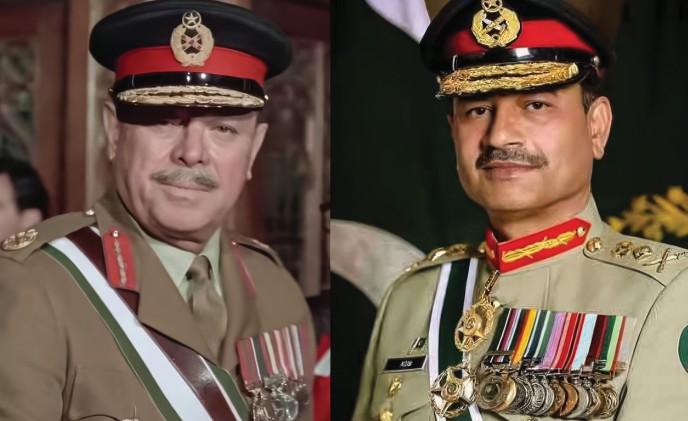
For a while, Field Marshal Asim Munir has everything going his way, a season of extraordinary rise and ease; the situation for which I admire the choice of words of The Guardian: ‘A King Above All: The Rise and Rise of Asim Munir, Pakistan’s Increasingly Powerful Army Chief’. Moreover, The Guardian declared Munir as ‘Trump’s favourite field marshal’. By repeating the word ‘rise’ in a single phrase, The Guardian leaves little room for ambiguity: when someone is already at the peak, a further ‘rise’ on top of that ascent is presented as something both striking and absurd.
In Pakistan, military titles are rarely just about rank. They often carry deeper political meaning, influence public discussion, and quietly shape how power is exercised. This is especially true for the title of Field Marshal, the highest rank in the Military Establishment. This title was last held by General Ayub Khan, who was elevated to the rank of Field Marshal in October 1959. With General Asim Munir now receiving the same rank on May 20, 2025, both moments naturally invite comparison. The two periods are different, yet the symbolism attached to the title raises important questions. How does becoming a Field Marshal affect Pakistan’s political space? Does it bring stability, or does it further weaken civilian authority?
Ayub Khan rose to the rank of Field Marshal during a time of open and direct military rule. After imposing martial law in 1958, he removed the civilian government and took full control of the state. A year later, he promoted himself to Field Marshal, a move that was deeply political rather than symbolic. The title placed him above all other generals and JANUARY 2026 strengthened his grip over both the military and civilian institutions. It reduced the chances of internal challenge within the army and sent a clear signal to politicians, the media, and society at large.
During Ayub Khan’s rule, political parties were sidelined, the press was tightly controlled, and public participation was carefully managed. Systems like Basic Democracies created an appearance of public involvement, but real power remained with the military ruler. In this period, the title of Field Marshal did not simply reflect authority; it helped normalise military dominance. Political space was not just reduced; it was effectively shut down. Civilian politics was pushed aside, and military rule was presented as necessary and permanent.
Munir’s elevation to Field Marshal is the same as that of Ayub Khan’s, but this time it took place in a very different Pakistan. Today, the country has an elected parliament, active political parties, functioning courts, and a media landscape that continues to speak, even under pressure. Unlike Ayub Khan, Asim Munir does not hold political office, has not suspended the constitution, and does not rule the country directly. These differences matter and must be acknowledged. In this moment, Pakistan is not under martial law, and formal democratic structures remain in place, but they are far from functioning as intended.
et Pakistan’s history shows that symbolism matters, especially when it comes to civil-military relations. The rank of Field Marshal carries strong historical and political weight. It signals authority, permanence, and exceptional status, both within the state and in the public imagination. While Asim Munir’s elevation does not close political space overnight, it may gradually reshape it in subtle but important ways.
The key difference between the two eras lies in how political space is affected. Under Ayub Khan, political space was openly closed. Opposition voices were quietened, civilian leadership was removed, and military rule was declared without ambiguity. Under Asim Munir, political space is not closed, but it is at risk of being quietly compressed and compromised. Civilian governments exist, yet they struggle to exercise full independence. And it seems that they don’t mind the current dispensation. Economic crisis, security challenges, and deep political polarisation have weakened elected institutions, creating conditions in which the military often steps forward as the ultimate problem-solver.
In such an environment, the title of Field Marshal strengthens the perception that the military is not only powerful but indispensable. This influence does not require tanks on the streets or emergency orders. Instead, it operates through unspoken boundaries, red lines that civilians learn not to cross. Over time, this quiet compression of political space can be just as damaging as overt authoritarianism.
Another important distinction lies in formal authority. Ayub Khan combined military leadership with political power, ruling as both army chief and head of state. Asim Munir does not occupy political office. However, Pakistan’s history shows that real power has often existed beyond formal titles. The rank of Field Marshal places its holder above routine command structures and may extend influence beyond normal tenure. This raises concerns about the long-term balance between civilian leadership and the military
The issue here is not of one individual, but of precedence. Once extraordinary ranks and roles become acceptable, they tend to repeat themselves. What begins as an exception can quietly become the norm.
A fair assessment must recognise that Asim Munir operates under constraints that Ayub Khan never faced. Social media, greater public awareness, and existing legal frameworks make direct military rule far more difficult today. At the same time, Pakistan’s democratic experience suggests that democracy does not always collapse through dramatic coups. Sometimes it weakens slowly, through symbols, habits, and gradual shifts of power away from elected institutions.
The title of Field Marshal carries historical baggage that cannot be ignored. Treating it as a neutral or purely ceremonial decision would be politically naïve. Comparing Field Marshal Ayub Khan and Field Marshal Asim Munir is not about judging specific personalities or questioning intentions; it is about understanding how power works in Pakistan and how it has historically reshaped political space.
Ayub Khan used the title to dominate politics and exclude civilian voices entirely. Asim Munir inherits the same title in a different system, but one where civilian authority remains fragile. Whether this moment leads to further shrinking of political space or remains a rare symbolic exception will depend on practice rather than promises. The important question is whether civilian politics will finally be allowed to grow on its own, or whether it will continue to function under the shadow of the Uniform and Stars. Pakistan’s future does not depend on titles, but on whether power learns to stay within its limits.
The writer is our Editorial Assistant and a journalist.