

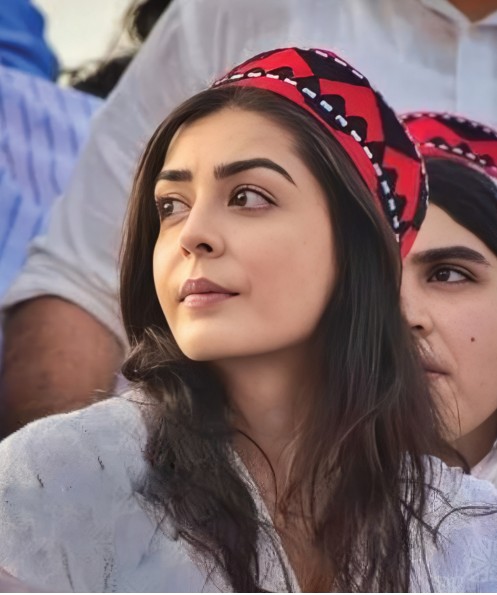
Imaan Mazari is a Pakistani lawyer and human rights activist who graduated from the University of Edinburgh. She emerged into public prominence largely because of her legal advocacy, outspoken positions, and willingness to directly confront state institutions. She is the daughter of Shireen Mazari, a senior politician, but Imaan deliberately carved out an independent public identity through litigation, courtroom advocacy, and political speech. From early on in her career, she positioned herself as a rights-based lawyer, frequently representing protestors, political workers, and those who questioned state’s abuse of power. Her activism-oriented legal practice, combined with a confrontational public style, quickly placed her at the center of controversy.
Practicing her advocacy and activism in Pakistan, Imaan Mazari is continuously engaged in legal battles and back-and-forth with the court and judges in Islamabad.
The first major flashpoint between Mazari and Islamabad High Court Chief Justice Sardar Sarfraz Dogar began on September 11, 2025, during a hearing on Mahrang Baloch’s petition to remove her name from the Exit Control List. The courtroom exchange escalated into a highly publicised clash, involving sharp remarks from both sides. CJ Dogar warned Mazari of a possible contempt of court case for allegedly referring to him as a ‘dictator.’
In the aftermath of that exchange, Mazari took the unusual step of filing a harassment complaint against the Chief Justice under the Protection Against Harassment of Women at the Workplace Act. She alleged that the conduct directed at her during court proceedings was gendered, hostile, and intimidating. The complaint itself became controversial, as it raised novel legal questions about whether and how sitting superior court judges could be subjected to such proceedings.
The controversy deepened when the administration within the Islamabad High Court altered the handling of her harassment complaint. Justice Saman Rafat Imtiaz, initially associated with the matter, was removed from that role, prompting Mazari to describe the move as unlawful. This development shifted the debate from being a personal matter to broader concerns about judicial independence and internal accountability.
Parallel to these events, a reference was filed by advocate Adnan Iqbal before the Islamabad Bar Council seeking cancellation of Mazari’s license to practice law. The reference accused her of conduct unbecoming of an advocate, including allegedly anti-state rhetoric and repeated attacks on state institutions. While such references are not uncommon in politically charged environments, this one drew attention because it directly threatened her professional standing rather than merely her public reputation.
Another strand of controversy arose from criminal proceedings initiated under Pakistan’s electronic crimes laws. Mazari and her husband were charged in connection with social media posts (Tweets on X) deemed objectionable by authorities. These proceedings raised further debate over freedom of expression, selective enforcement of cybercrime laws, and whether political speech was being criminalised. The matter moved through multiple judicial forums, adding to her legal entanglements.
Supporters see Imaan Mazari as a lawyer who persistently challenges entrenched power structures at personal cost. Critics view her as confrontational, intemperate, and damaging to institutional decorum. What is beyond dispute is that her career has unfolded under sustained legal, professional, and political pressure, making her one of the most polarising legal figures in contemporary Pakistan.
Mazari’s repeated framing of her legal troubles as part of a broader pattern of repression has further entrenched polarisation. She has consistently portrayed herself as facing consequences not for misconduct, but for challenging powerful institutions and representing unpopular and controversial clients. This narrative resonates strongly with civil society groups and younger lawyers, while simultaneously hardening opposition from those who see her actions as destabilising or irresponsible.
Even her resignations and withdrawals from professional bodies have added to the controversy rather than closing chapters. Each departure has been accompanied by public statements accusing institutions of moral failure or cowardice, ensuring that internal disputes become public debates. This approach has strengthened her image as an uncompromising dissenter but has also isolated her within segments of the legal fraternity.
Over time, what stands out is not a single defining case but the accumulation of disputes across courts, bar councils, regulatory bodies, and criminal forums. The controversies feed into one another, creating a cycle in which legal action leads to public criticism, which in turn invites further legal or professional challenges. This cycle has made Mazari a constant presence in legal and political news, regardless of whether individual cases are dismissed, stayed, or remain pending.
In essence, Imaan Mazari’s story is less about isolated allegations and more about sustained confrontation with authority. She occupies a space where law, politics, gender, and dissent intersect, making every dispute symbolically larger than its immediate facts. Whether she is ultimately remembered as a principled rights lawyer who paid a heavy price, or as a polarising figure who pushed institutional boundaries too far, will depend not only on court outcomes but on how Pakistan’s legal culture evolves.