

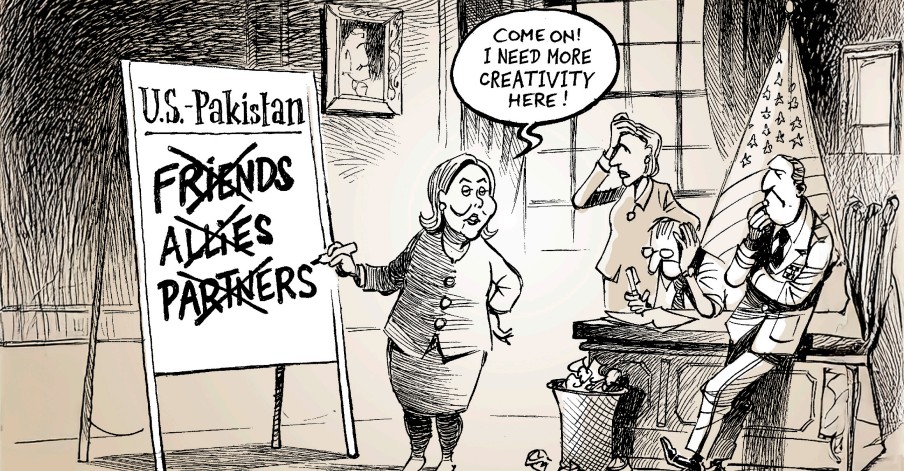
Soon after independence, daily newspapers in Pakistan contained political cartoons that developed and sustained a powerful visual commentary on politics, sovereignty, and foreign relations. Most notably in the 1960s, both English and Urdu dailies, such as Dawn, Jang, The Nation, and Nawa-i-Waqt, heavily relied on political cartoons to frame their commentary on Cold War alignments, military rule, and Pakistan’s dependence on the US. In many of these cartoons, the US took a myriad of forms, often rendered as an ally, patron, and a threat to national sovereignty. Drawing on inherited South Asian caricature traditions and modernist graphic economy, cartoonists relied on exaggerated physiognomy, emblematic figures, and stark line work to translate geopolitics into a visual allegory
During the Afghan Jihad and its aftermath, the satirical political cartoons became confrontational. The cartoons often blamed US policy for domestic instability and for making Pakistan a site of strategic compromise. From the 1990s onward, the political cartoon functioned as a regular editorial form, responding to sanctions, nuclear tests, the war on terror, drone strikes, and diplomatic crises through recurring motifs of coercion and loss of sovereignty. In the contemporary press, these cartoons continue to condense complex US-Pakistan relations into compact visual arguments, combining humour, distortion, and symbolic shorthand to produce a durable graphic record of political commentary.
There are several recurring themes dominating the visual field in cartoons regarding US-Pakistan relations. The most persistent was asymmetry of power, commonly staged through disproportionate bodies, scales, or spatial hierarchies that cast the United States as oversized and Pakistan as constrained or burdened. Dependency appeared through motifs of aid as a leash, crutch, or transaction, often visualised as labelled sacks of dollars or documents bearing demands. Distrust formed another central theme, with cartoons repeatedly invoking masks, double faces, or shadow figures to suggest hidden intentions on both sides. Sovereignty and violation emerged through imagery of intrusion – boots, drones, hands crossing borders – compressing abstract policy into bodily metaphors. All these themes relied on a symbolic vocabulary that allowed the critique to be articulated and delivered through quick, punching visuals instead of overt, lengthy political analysis.
The cartoons relied on a highly effective set of visual devices that watered down a complex geopolitical narrative into a more accessible format. Caricature was central to this critique as political actors were drawn with exaggerated faces or gestures to signal political dominance. The United States often appeared as an outsized figure (frequently Uncle Sam) whose scale alone established unequal power relations. Allegory functioned as a second key device. Abstract ideas such as sovereignty, aid, or betrayal were translated into concrete objects such as chains, leashes, sacks of dollars, documents, or trees to exhibit policy negotiations as transactions. Symbolic shorthand structured most compositions. These devices drew on long traditions of political caricature while adapting them to local experience, producing images that were both accessible and analytically dense without relying on verbal argument. Drones stood in for US military presence, boots for violation, and borders for threatened autonomy. These symbols circulated repeatedly, creating a shared visual vocabulary that readers recognised instantly. Spatial arrangement also carried meaning. Pakistan was placed beneath, cornered, or weighed down, while US figures occupied elevated or central positions, reinforcing hierarchy through composition rather than text. Irony and visual contradiction sharpened the critique, as gestures of friendship were paired with weapons, contracts, or hidden hands.
Cartoons critiquing US policy in the post-9/11 period depicted the alliance with Pakistan as unequal, coercive, and morally compromised. The United States was commonly depicted as an imposing figure whose gestures of partnership concealed demands, surveillance, and force, while Pakistan appeared caught between compliance and loss of autonomy. Visual devices emphasised pressure rather than choice: aid was shown as bait, documents as ultimatums, and military cooperation as a physical burden. The imagery often juxtaposed symbols of friendship with instruments of violence, exposing the contradiction between the language of alliance and the realities of the war on terror. Through compressed scenes and familiar symbols, these cartoons reframed global counter-terrorism policy as a local experience of constraint, revealing scepticism toward US intentions without relying on textual argument.
Cartoons responding to the Osama bin Laden operation framed the episode as a rupture of Pakistan’s sovereignty and political credibility. The unilateral US raid was visualised through images of intrusion (boots on domestic ground, helicopters crossing borders, or oversized foreign hands acting without consent), framing the US military action as a blunt violation of authority. Pakistan’s state institutions were drawn as absent, embarrassed, or paralysed, conveying external humiliation and internal failure. For instance, Nawa-i-Waqt on May 16, 2011, published a cartoon to reflect Pakistan’s embarrassment caused by the US’s politics of betrayal. The cartoon showed a personified Government of Pakistan holding a tiny saw to cut a huge tree of embarrassment, causing trouble to Pakistan as a result of the Abbottabad operation. Irony dominated the visual language: claims of partnership appeared alongside scenes of secrecy and disregard, exposing the imbalance embedded in the relationship. By compressing the event into stark allegorical scenes, these cartoons transformed a complex security operation into a visible crisis of autonomy, accountability, and trust.
These political cartoons matter because they translate distant diplomacy into everyday visual language. By condensing power relations, violations, and contradictions into recognisable symbols, they shape public understanding, preserve dissent within constrained media spaces, and create a visual record of how global politics is experienced locally