

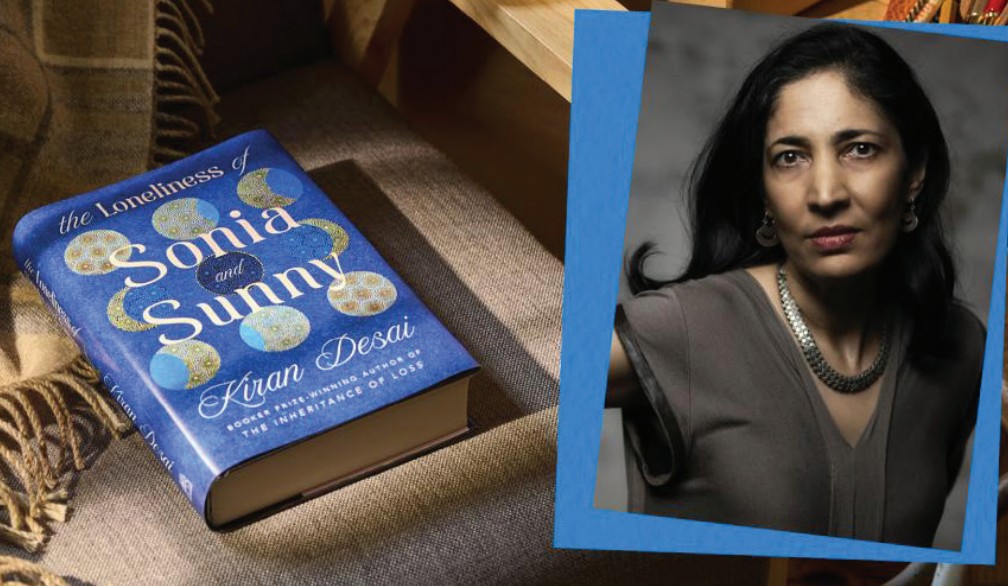
I t takes a literary genius to paint the inner worlds and introspections of characters in the way that Kiran Desai has done in this book. This novel, written after almost a decade and shortlisted for The Booker Prize 2025, manages to go beyond by getting into the minutiae of not only the main characters (Sonia and Sunny), but also others. And to have an author capture the social, political, cultural, and economic issues across continents, time zones, and time itself is a feat in itself.
The book centres primarily on the lives of two young individuals, both living in the United States with their Indian roots. Unacquainted and unknown to each other, their families know each other through family connections, and there is a quest for an arranged marriage by Sonia’s parents due to her feelings of loneliness. Sonia is an aspiring novelist, studying in Vermont, and upon finishing her degree, she returns to India, New Delhi. Back in the United States, she gets involved in a relationship with the kind of narcissistic man who is a walking and talking red flag. The kind of man that your best friend warns you about, but you do not listen to her because he is charming in public, but other hand, resides in New York, a struggling journalist.
At the book’s outset, he is involved in a live-in relationship with an American girlfriend, a fact that he has hidden from his mother. He seems lost, and remains lost throughout the book, trying to find his way, grappling with his mother’s high standards of success, who is unwilling to cut the proverbial umbilical cord. Several chapters into the book, their two worlds collide, and they enter and exit each other’s worlds, due to circumstances, commonplace man cowardice, and an overbearing Indian mother.
Sonia and Sunny are the only children of their respective parents, and South Asians would understand the kind of pressure that this bestows upon the only child. Sonia’s parents are ‘modern,’ and she is attaining higher education in the United States. Sunny’s mother is the typical Indian mother, obsessed with her male child, who wants him to do the best in the world. And it would not be a true South Asian story if inheritance drama was not thrown into the mixture. Sunny’s father died, leaving his mother to fend for the right to the residential property in which they all reside from his paternal uncles. There you have it, the classical Indian drama. But interestingly, it is not typical in the sense that it is boringly clichéd. It is sufficient to plunge the reader in.
However, it is also not the kind of book that you whizz through. After all, it spans over 600 pages. Desai is not an uncomplicated writer; while she refrains from the use of difficult words, the themes that she paints in her novels are still those that need moments to reckon with. At times, there are also too many details, at least in this book.
Desai touches upon contemporary themes in this novel. You have the family drama, romance, the cheating spouse, and also climate change, as the smog in New Delhi is also covered. There is also the usual escape to Goa, which seems to happen in most books written by an Indian author, thereby reflecting the lived realities of urban Indian lives. And it is also a classical diaspora fiction – both Sunny and Sonia struggle to adapt to life in the modern United States. Loneliness is a central figure in the book, as the title suggests. Sunny remarks, ‘All the best people in the world are lonely.’ In fact, Desai depicts Sonia in some sort of depression, although this is an area that could have been highlighted more.
And if this is not sufficient to capture the attention of those who are bored with the usual diaspora stories, you also have American Gothicism in this book. Personally, since it seems so far from reality, I seemed to gloss over this, but others seeking a psychological thrill would find this aspect appealing. You have talismans, mysticism, spiritual and chance encounters, reality merging into fantastical worlds. And through this, in a way, Desai has confronted the stereotype around Indian authors who write about the diaspora. They can absolutely explore dark romanticism and American Goth.
By packing complex and uncomplex themes into a crowded novel filled with different characters, Desai has managed to create a remarkable, atypical piece of fiction. This book is highly recommended for South Asians, who can connect immediately to themes explored therein.
The writer is an Assistant Professor at CBEC-SIUT, and our Managing Editor.