

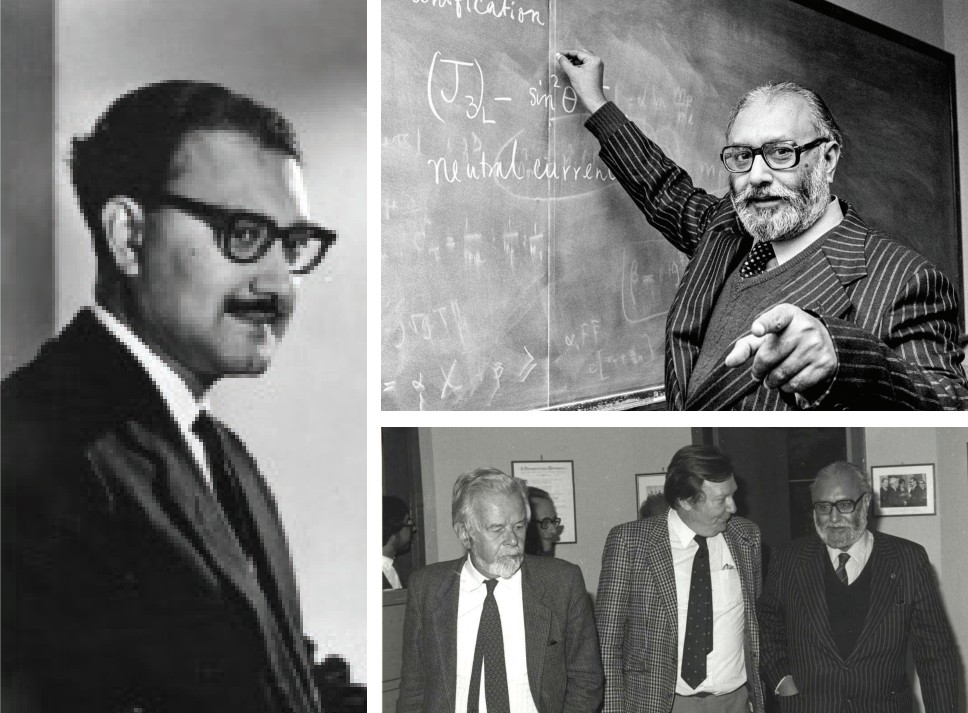
As a noble laureate who united the realm of physics with nuclear innovation and brought it to the developing world, Dr Abdus Salam is one of the greatest pioneers of Pakistan who, despite his achievements, has been relegated to the backdrop owing to his religious affiliations. Born in British India to a modest Ahmedi family, he showcased exceptional talent in Mathematics that won him a scholarship at Cambridge University, whereby he not only won the ‘Smiths Prize’ for his research but also received first honours in Mathematics and Physics.
Once he completed his PhD in ‘Theoretical Physics’, he returned to Pakistan in the hopes of teaching and decided to embark on a journey to enlighten the nation with his knowledge. However, his frustration with the country’s poor scientific infrastructure and a wave of discrimination against the Ahmedi community led him to return to the United Kingdom and teach at Imperial College London in 1957, where he formed a group of physicists who gained international fame for their work in ‘Quantum Field Theory’ and ‘Particle Physics’. His groundbreaking contribution came in the form of electroweak unification – a theory that merged electromagnetic and weak nuclear forces, which became a pillar of the Standard Model of Particle Physics. For this, he shared the 1979 Nobel Prize in Physics with Sheldon Glashow and Steven Weinberg.
Not only that, but Salam also played a crucial role in promoting science in the developing world. He founded the International Centre for Theoretical Physics (ICTP) in Trieste, Italy, in 1964 to support scientists from less-privileged countries and served as its director until his death. In Pakistan, he served as Science Advisor to the government under Ayub Khan’s martial rule from 1960 to 1974 by establishing key scientific institutions like SUPARCO. However, his achievements were overshadowed by the religious persecution faced by the Ahmadiyya community. Following Pakistan’s 1974 constitutional amendment declaring Ahmadis non-Muslims, Salam distanced himself from the country, although he never renounced his love for it. He died in 1996 in Oxford and was buried in Pakistan, though the word ‘Muslim’ was legally removed from his gravestone.
Despite the challenges, Dr. Abdus Salam remains a towering figure in global science. His legacy lives on through his scientific contributions, his institution-building efforts, and his advocacy for science in the Muslim world and developing nations. He is remembered as a brilliant mind who combined intellect with deep humility and commitment to humanity.