

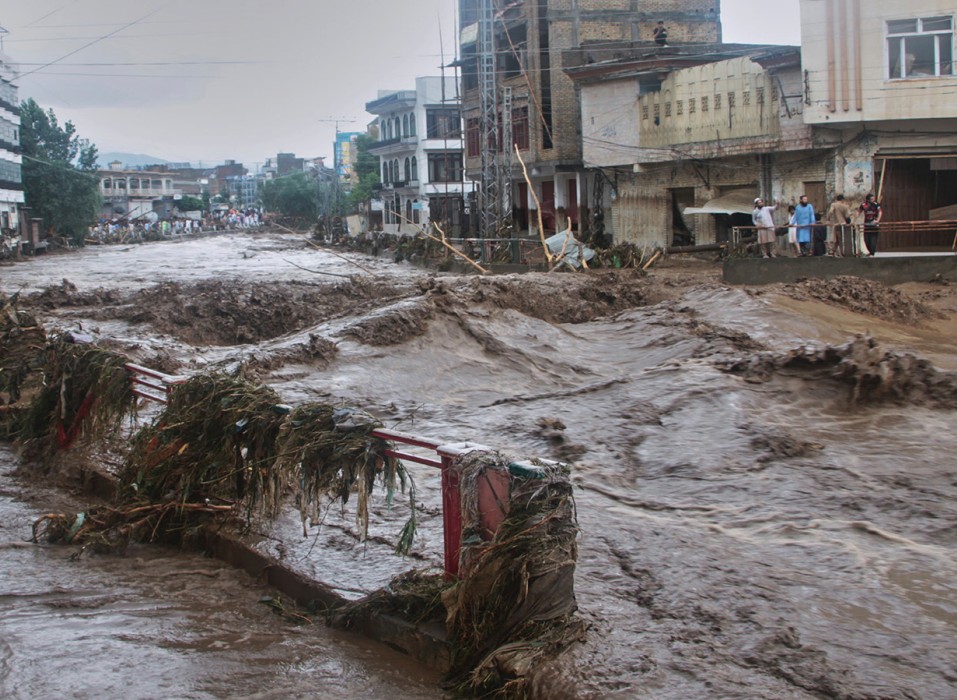
Every monsoon, Pakistan’s landscape undergoes a dramatic transformation; rivers swell, plains are submerged under torrents of water, and entire communities are displaced. But beneath the rising waters lies another storm, one driven not by nature but by politics. The floods that devastate Pakistan each year also expose deep rifts between its provinces, revealing a pattern of blame, mistrust, and political maneuvering that hinders the country’s ability to respond effectively. What should be a story of collective resilience often turns into a struggle for power, resources, and recognition.
Pakistan’s geography has long made it vulnerable to flooding. The mighty Indus River system, fed by Himalayan glaciers and monsoon rains, weaves through Khyber Pakhtunkhwa, Punjab, Sindh, and Balochistan before reaching the Arabian Sea. It is a lifeline but also a flashpoint. The same waters that sustain Pakistan’s agriculture can unleash destruction when monsoon patterns intensify or when management systems falter. Climate experts have repeatedly warned that the country is among the most climate-vulnerable in the world, and studies by organisations like the Asian Development Bank and UNDP confirm that flood risks are growing each year. Despite this foreknowledge, the response remains mired in politics.
As Pakistan emerges from another destructive monsoon season in 2025, the floodwaters have left behind not just ruined homes and submerged farmland, but also renewed political fault lines between provinces and between the federal and provincial governments. The scale of devastation, thousands displaced, harvests destroyed, and infrastructure damaged, has triggered emergency declarations, parliamentary debates, and fierce political posturing. Once again, the flood crisis has exposed weaknesses in governance, coordination, and accountability, while highlighting how the politics of disaster have evolved amid intensifying climate challenges.
The federal government, led by Prime Minister Shehbaz Sharif, has declared both climate and agricultural emergencies following the widespread destruction. The move reflects not only the worsening environmental realities but also the mounting pressure from provinces that have suffered severe damage, especially Punjab, Khyber Pakhtunkhwa, and Sindh. Officials have warned that the flood ‘deluge’ moving southward threatens to submerge more of Sindh’s low-lying areas, exacerbating the humanitarian crisis.
Political leaders have responded with urgency, but also with the familiar tone of blame. Bilawal Bhutto-Zardari, Chairman of the Pakistan Peoples Party (PPP), has called for a unified national response, stressing that no single province can handle such disasters alone. He also appealed for federal assistance to rebuild homes and restore livelihoods in floodhit areas of South Punjab. Members of the National Assembly, from both government and opposition benches, have echoed the need for new water reservoirs to increase the country’s storage capacity and prevent such large-scale disasters in the future.
Punjab, the country’s most populous province, has been hit particularly hard. The Sutlej, Ravi, and Chenab rivers have swelled beyond their banks, inundating vast stretches of land in Layyah, Taunsa, Dera Ghazi Khan, Rajanpur, and Muzaffargarh. Millions have been displaced, and thousands of acres of standing crops have been destroyed. The provincial government has faced criticism for delayed warnings and inadequate maintenance of embankments. While officials claim that rescue operations were swift and well-coordinated, opposition lawmakers and local communities insist that the response was reactive rather than preventive.
Khyber Pakhtunkhwa, meanwhile, has suffered from flash floods caused by intense cloudbursts in mountainous areas. Dozens of villages have been washed away, roads destroyed, and access to remote regions cut off. The provincial government has come under pressure to improve early warning systems, strengthen coordination with the National Disaster Management Authority (NDMA), and ensure timely compensation to affected families.
Critics argue that years of underinvestment in flood control infrastructure, coupled with bureaucratic delays, have made the province increasingly vulnerable to such disasters.
Sindh, located downstream, faces the looming threat of floodwaters flowing south from Punjab. The provincial leadership has urged the federal government to fully engage NDMA and coordinate with local authorities to prepare for the incoming surge. Sindh’s government has already issued high alert notices for districts along the Indus River, especially around Guddu, Sukkur, and Kotri barrages. The chief minister has warned that without immediate federal support, the province could face another large-scale humanitarian crisis similar to 2022, when floodwaters submerged one-third of the province.
At the core of the tension lies a recurring issue: poor coordination and inadequate early warning systems. The Prime Minister has directed all provinces to carry out detailed damage assessments using satellite technology, including losses to crops, livestock, and infrastructure. Opposition leaders, however, have accused provincial administrations of negligence and the federal government of failing to ensure equitable relief distribution. Disputes have also surfaced over how compensation should be routed, with some calling for funds to be disbursed through the Benazir Income Support Programme to ensure transparency and fairness.
A familiar fault line in Pakistan’s flood politics revolves around the debate over solutions. Politicians from both sides of the aisle agree that new dams and reservoirs are essential, yet they differ sharply on the balance between large-scale infrastructure and local adaptation measures. While proponents of mega projects argue that more dams will regulate water flow and prevent flooding, however, environmental experts and activists warn that overreliance on such projects without addressing deforestation, siltation, and encroachment on floodplains may worsen long-term risks. This debate reflects a broader political divide: whether Pakistan’s flood management strategy should prioritise engineering solutions or community-based resilience.
The allocation of resources has also become a flashpoint. Provinces continue to accuse one another of mishandling water releases and neglecting maintenance of barrages and embankments. Downstream provinces, particularly Sindh, allege that upstream provinces such as Punjab fail to provide adequate warning before discharging water, leading to devastating consequences. These accusations are not new but have gained renewed intensity as the political climate grows more polarised.
Flood response has also become a stage for political visibility. The visits of high-ranking officials to disaster zones, the formation of committees, and repeated press briefings often serve dual purposes: demonstrating empathy while reinforcing political narratives. The military’s visible involvement in rescue and relief operations, praised by many for its efficiency, has also highlighted gaps in civilian capacity. For ordinary citizens, however, such political optics offer little comfort as they struggle to rebuild their lives amid mounting economic pressures. In the aftermath of this year’s floods, several key trends are emerging. There is a growing realisation among policymakers that climate risk must be institutionalised through longterm planning, not just emergency declarations. Provinces are demanding clearer federal mechanisms for coordination, data sharing, and resource distribution. Meanwhile, citizens and civil society groups are increasingly vocal in demanding transparency in aid disbursement and accountability for past failures.
The challenge, however, remains formidable. Despite repeated disasters, Pakistan’s approach to flood management continues to rely on reactive measures rather than preventive planning. Urban encroachments on floodplains, deforestation in northern watersheds, and poor maintenance of river embankments have all contributed to escalating damage. Experts warn that unless these structural issues are addressed through coordinated policy reform, the cycle of destruction, blame, and political exploitation will continue.
Floods in Pakistan are no longer just environmental events; they have become a mirror reflecting the country’s political and administrative fractures. The deluge that sweeps across the Indus basin each year does more than inundate land; it washes away the illusions of preparedness and unity. Until Pakistan’s leaders rise above provincial rivalries and prioritise collective resilience over political gain, the waters will keep returning not only to claim lives and livelihoods but to expose, time and again, the fault lines in the nation’s governance.
The writer is our Editorial Assistant and a journalist.